Almost six months later, the Dallas Mavericks’ jettisoning of superstar guard Luka Doncic to the Los Angeles Lakers still feels surreal.
The most shocking blockbuster trade of the NBA’s past decade didn’t affect the playoff bracket all that much — the Lakers’ duo of Doncic and LeBron James couldn’t advance past the Western Conference’s first round, while the injury-prone Mavericks struggled to just get to the play-in tournament a year after making the Finals — but the logic behind the deal defies belief. Dallas traded Doncic, one of the top five NBA players and one of the league’s top young talents, and received veteran big man Anthony Davis, a star in his own right but an older and more injury-riddled piece with less trade value, in return.
If the NBA’s quartet of California teams, the Warriors, Lakers, Clippers and Kings, didn’t seem star heavy-enough before the deal, poaching Doncic infused the state with a new alpha superstar to succeed James, Golden State’s Steph Curry and the Clippers’ Kawhi Leonard (a group that boasts a combined 10 NBA championship rings). And the Lakers aren’t letting Doncic go any time soon — the Slovenian guard agreed to a three-year, $165 million deal to kick off August, according to ESPN.
But in the pursuits of the reigning NBA Finals champion Oklahoma City Thunder and of Western Conference supremacy for the next decade, the Golden State’s teams are not the group best positioned for success. Thanks to a stellar offseason by all three of its teams, the territory that let Doncic get away, the state known as Texas, has supplanted California as the center of the NBA universe and boasts three teams that can legitimately scare the Thunder (and its attempt at building a dynasty).
No Texas team has won the NBA Finals since the San Antonio Spurs in 2014, while California has captured five trophies in that span. The trajectory of the Spurs, Rockets and even Doncic’s former employer, the Mavericks, will test that drought over the next five years and beyond.
Let’s start with the Rockets, who ascended to the Western Conference’s second seed in 2024-25 and landed the biggest splash acquisition of the summer. Houston swapped out inconsistent guard Jalen Green for 15-time NBA All-Star forward Kevin Durant, who earned an All-Star game nod and registered the sixth-highest points per game total in the NBA (26.6 points per game) in his age-36 season. While Green was one of the key figures of the Rockets rebuild and has cracked the 20-points-per-game barrier in two of his four seasons, Houston succeeded acquiring a proven scorer in Durant while retaining star big man Alperen Sengun and former top-five picks Jabari Smith Jr. and Amen Thompson.
With 52 wins in 2024-25 and one of the NBA’s best defenses, the Rockets demonstrated that the rebuild was complete. Durant’s arrival signals another stage — legitimate championship contention, all-in contention.
In addition to the Rockets, the Mavericks have somehow re-entered the championship conversation after the jarring Doncic trade. General manager Nico Harrison’s rationale for trading Doncic, the Mavericks’ most promising player, hardly satisfied the fanbase, but if Anthony Davis can stay healthy, Dallas has the pieces to contend in the Western Conference. Guard Kyrie Irving will also be a key figure in the backcourt and boasts a sterling Finals resume, though he is set to miss at least the rest of the 2025 calendar year with an ACL injury.
That’s a lot of if’s, but Dallas landed the best addition of any team in the NBA this summer: first overall draft pick Cooper Flagg. Despite a 1.8 percent chance of the ping-pong balls of the NBA’s Draft Lottery bouncing their way, the Mavericks ended up with the first pick (for the first time in franchise history, and with the fourth-lowest odds of all time for a team that won the first overall pick) and made their intentions clear for the first pick. The former Duke star took the college basketball world by storm last winter and spring and emerged as one of the best draft prospects of the 21st century. Sticking him on a cellar dweller like the Wizards or Jazz would not have hindered Flagg from success as a pro, but the chance to learn from two future Hall of Fame players in Davis and Irving — while not having the pressure to immediately become his team’s top option each night — bodes well for Flagg’s development and the short- and long-term outlooks for the Mavericks. Doncic will never be forgotten in Dallas, but Flagg’s defensive prowess and projection as a future superstar restores optimism in the Mavericks’ fanbase after a harrowing, soul-searching winter.
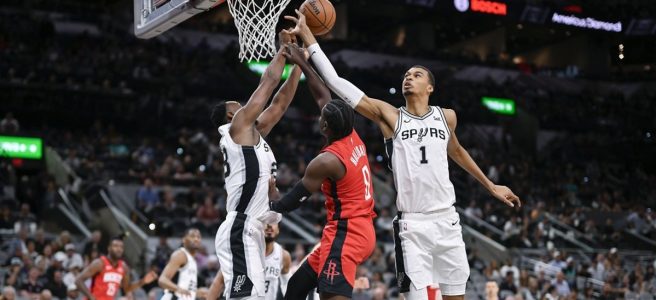
Set aside those two Western Conference contenders, and the team that is left just happens to be the most threatening of the bunch. The San Antonio Spurs didn’t have the top trade acquisition or the number one draft pick this offseason. Instead, they lost one of the greatest coaches in the history of the sport, Gregg Popovich, to retirement. Franchise star Victor Wembanyama is coming off a season-ending blood clot in his right shoulder, and the team’s 2024-25 record was a mediocre 34-48. The Spurs haven’t been a factor in the playoff picture in a while — their 34 wins tied their highest win total in the past six seasons. And 38-year-old head coach Mitch Johnson, Popovich’s replacement, is an unproven commodity and is stepping into a full-time head coaching role for the first time (he was the interim head coach last season in Popovich’s absence).
I’m still bullish on the Spurs’ long-term outlook and am optimistic in San Antonio’s ability to ascend to contender status sooner than most outside observers expect. All optimism in San Antonio starts with the 7-foot-3 Wembanyama, who has entrenched himself as the NBA’s best defensive player and averaged 24.3 points per game as a 21-year-old last season. In addition to boasting the No. 1 overall pick in the 2023 Draft in Wembanyama, the Spurs’ roster features the 2024-25 Rookie of the Year in Stephon Castle, the No. 2 pick of this year’s draft, Dylan Harper and last year’s big-name trade acquisition, veteran point guard De’Aaron Fox. That is a ton of upside and some serious talent for Johnson to work with in molding the Spurs from a promising squad on paper into a squad that can threaten the Thunder in the coming years. The Spurs’ organizational stability (especially compared to the Mavericks’ new ownership group and the Rockets shaky track record) is an asset itself. Popovich can never be replicated or replaced, but the team he’s left to his successor has the potential to match up with the dynasty-level teams Popovich once led and the organizational infrastructure to boost, rather than damage, that trajectory.
Aside from Luka Doncic himself, it’s difficult to find an advantage that the Texas teams don’t boast. The state features two former No. 1 picks (Wembanyama, Flagg), two former No. 2 picks (Durant, Harper), two head coaches with NBA Finals experience and three players putting up prime numbers who would likely make the Hall of Fame if they retired today (Durant, Irving, Davis). The best is yet to come for Texas basketball, which may be the scariest part.
Contrast that with the California teams, who have shaped the story of the NBA over the past 10 years but are nearing the end of their contention windows.
The Lakers’ window will be open as long as Luka Doncic is in purple and gold, but Los Angeles didn’t make much playoff noise even with the high-flying Doncic-James combo and have to start preparing for the 40-year-old James’ retirement or departure. The Warriors are in a similar situation with Curry, as they look to make the most of the remaining years of his prime while relying on a makeshift and unreliable supporting cast. The Clippers’ duo of James Harden and Kawhi Leonard were healthier and more productive in 2024-25, but their efforts amounted to a first-round exit to Denver and both players are 34 or older. Their free-agent additions, Chris Paul and Bradley Beal, are 40 and 32! The Sacramento Kings were never in serious championship contention and seem locked in perpetual rebuild mode, with its star trio of DeMar DeRozan, Zach LaVine and Domantas Sabonis all 29 or older. None of these four teams appear to be significant threats to the Thunder in the 2025-26 season, and only the Lakers seem to have some semblance of a succession plan to their current core.
Obviously, there’s not much competition for the state with the best arsenal of NBA teams. Aside from California’s four and Texas’s three, only Florida and New York can claim multiple NBA teams. But regardless of the winner of the arbitrary claim of best NBA state, Texas’s stockpiling of NBA talent is astounding and a notable shift in today’s NBA.
At the moment Doncic was traded on February 1, the Texas NBA landscape looked barren — two teams ranked in the bottom half of the Western Conference and another, the second-seeded Rockets, that had never played in the playoffs with its core of young players. Six months later and heading into a promising NBA season, Texas is riding high, with an influx of draft picks, key free agent and trade pickups and optimism spread across all three fan bases. The Thunder’s dominant run to its first NBA championship in Oklahoma City is fresh in the minds of those around the league, but its neighbors to the south could pose the greatest danger to OKC’s bid at league domination.
 Riker's Block