Full disclosure: college football has changed so much over the past half-decade that I felt it was necessary to complete a sweeping review of the sport’s recent developments before choosing my champion.
Some moves have been overwhelming successes: the return of the EA Sports College Football video game, an expanded College Football playoff and the groundbreaking measures that paved the way for athletes to earn money through name, image and likeness and additional compensation from both companies and their schools. Others are head-scratching and downright demoralizing for college football fans: extreme conference alignment that has stretched conferences from coast to coast in the name of TV money and dissolved the Pac-12, threatened rivalries and the dysfunctional, Wild West-like implementation of the new NIL rules.
Whether those seismic rule changes represent a net positive or negative change for college football is a matter of opinion, but at the very least, the wave of changes justify a quick debrief of the rule changes. In terms of crowning college football’s champion, that means a quick examination of the college football playoff.
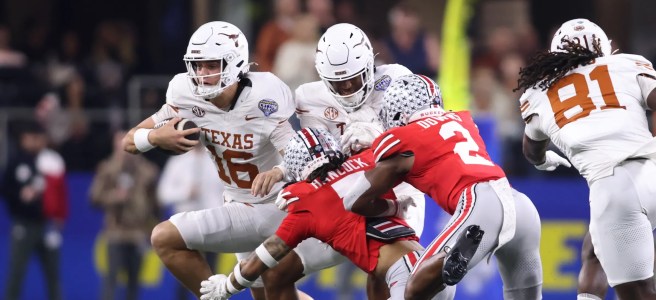
After years of a four-team college football playoff, the committee expanded the playoff field to 12 teams, with 11 single-elimination games determining a battle-tested champion. In accordance with the tradition of college football, the Rose Bowl, Sugar Bowl, Orange Bowl, Cotton Bowl, Fiesta Bowl and Peach Bowl earned spots to serve as the quarterfinal and semifinal hosts. Eight seed Ohio State and seven seed Notre Dame, two teams that likely would not have made the playoff under the previous format, survived a stacked field of playoff entrants and clashed in the national championship game, a 34-23 Buckeye win in Atlanta. The first year of the playoff introduced a playoff format that made the competition for a championship more accessible and featured plenty of surprises and excitement — clear upgrades from the previous model.
In comparison, Year Two will have more modest changes. Instead of mandating that all four top seeds have to be conference champions, there will be no such mandate in the format going forward. The field will feature the five highest-ranked conference champions and seven at-large teams that are the next-highest seeded — virtually ensuring lower-seeded conference champions in power conferences will make the playoff but not securing a top-four spot and a first-round bye. Under this format, Boise State (the third seed in the 2024 bracket but only the 9th overall team in the poll) and Arizona State (the fourth seed in the 2024 bracket but only the 12th overall team in the poll) would have to play in the first round as a road team, rather than benefit from the luxury of the status of a top-four team. The tweak may not even affect this year’s field, but it rewards the regular season’s best teams more effectively while still ensuring conference champions make the field.
With that exposition out of the way, the 2025 college football season will be thrilling, even before the reworked College Football Playoff rolls around.
The Texas Longhorns and new starting quarterback Arch Manning are the team to watch, already standing as championship and Heisman Trophy favorites, respectively, but the SEC gauntlet makes their championship hopes no sure thing. Reigning champion Ohio State reloaded but will rely on a plethora of new faces to restore their status as the team to beat in the Big Ten, while Penn State, another 2024 playoff entrant, is leaning on its returning offensive superstars to finally put the pieces together for a postseason run. The heat is on Alabama to make the College Football Playoff after being the first team out of the tournament in head coach Kalen DeBoer’s first year and suffering uncharacteristic upset losses. And programs from across the power conferences will look to replicate the underdog, out-of-nowhere runs of Indiana and Arizona State and make their dreams of postseason glory come through.
Big Ten Champion: Penn State Nittany Lions
Why the Nittany Lions are scary: Experience. Penn State’s prolific offense returns three of its stars: quarterback Drew Allar and running backs Nicholas Singleton and Kaytron Allen. The trio of seniors lifted Penn State to a 13-3 record and a pair of College Football Playoff wins last season, before the Nittany Lions bowed out to the Notre Dame Fighting Irish in the Orange Bowl. With top tight end Tyler Warren departed for the NFL, the receiving corps will rely on transfers Devonte Ross and Kyron Hudson, but Penn State is strong on both sides of the trenches and has a very manageable schedule, with a Nov. 1 test at Ohio State looming as the premier matchup of the regular season. Penn State is in excellent shape to win its second Big Ten football title of the 21st century (2016 was its most recent), but after reaching the final four last year and luring back its stars from the pro level, a conference title alone would just be the start.
SEC Champion: Georgia Bulldogs
Why the Bulldogs are scary: Coaching. For a program that always seems to be in the mix for the national championship, Georgia enters 2025 with a lot to prove. Junior Gunnar Stockton steps in at quarterback for transfer portal loss Carson Beck, while a Georgia rushing attack that ranked 15th out of 16 SEC teams will look to running backs Nate Frazier and Chauncey Bowers to reignite the Dawgs on the ground. Even with these question marks, head coach Kirby Smart has earned the benefit of the doubt. Smart enters his 10th year at Athens with a stellar 105-19 record and two national championships, and turned last year’s adversity into an SEC overtime championship victory over the Texas Longhorns. Georgia will have an excellent chance to defend the SEC crown from a very loaded field of contenders and could earn a chance at redemption in the College Football Playoff bracket if the offense reaches a championship-caliber level under Smart’s supervision.
Big 12 Champion: Kansas State Wildcats
Why the Wildcats are scary: Consistency. Last year’s race for the Big 12 title felt like a Kentucky Derby finish, and the top of the standings in 2025 could be similarly competitive — even if only one team makes the College Football Playoff. Colorado lost superstars Travis Hunter and Shedeur Sanders, while Arizona State will have to replace its top player, running back Cam Skattebo, in its hunt for a return to the CFP. They may not be a national phenomenon or a CFP Cinderella, but the Kansas State Wildcats have been lurking in the Big 12 for years and are ready to pounce for a conference title. Head coach Chris Klieman has led the Wildcats to at least nine wins in each of the past three seasons, including a Big 12 championship in 2022, and has a talented team starring quarterback Avery Johnson and wide receiver Jayce Brown. Kansas State plays fellow Big 12 contender Iowa State in Ireland this Saturday to kick off its season, and a conference victory overseas would prove the Wildcats are ready to take the next step and can be the class of the Big 12.
ACC Champion: Clemson Tigers
Why the Tigers are scary: The quarterback. With Miami standout Cameron Ward now in the NFL as the first overall draft pick, senior Cade Klubnik out of Clemson steps up as the most promising quarterback in the ACC — and maybe the nation. As a junior, Klubnik threw 36 touchdown passes against only six interceptions, while also ranking in the top ten in the nation in passing yardage. Klubnik will return all three of his top receivers, including All-ACC selection Antonio Williams, and gives Clemson a clear advantage over ACC contenders Louisville and Miami, who both are starting new passers. Clemson has risen and fallen as a championship contender with its quarterback play, and another special season by Klubnik and Clemson’s high-powered and experienced offensive attack would affirm the Tigers squarely in the national title conversation.
Next-Highest Conference Champion: Navy Midshipmen
Why the Midshipmen are scary: Opportunity. The current College Football Playoff system ensures that one conference champion from outside the Power Four conferences gets a shot at all the glory — Boise State and Ashton Jeanty ran away with that spot last season. With Jeanty gone, I’m projecting that bid as a four-team race between teams from the Mountain West and the AAC: Boise State, UNLV, Tulane and Navy. Of those four, I’m most excited to see what the Midshipmen can accomplish and if a service academy (and a Maryland school!) can break into the College Football Playoff in its second year. Navy boasts its conference’s best quarterback in Blake Horvath (1,254 rushing yards, 17 touchdowns in 2024) to go along with a stout defense (22.2 points per game allowed, third in the AAC). Navy will not play Tulane in the regular season, but victories in its Nov. 8 matchup against Notre Dame or Dec. 13 rivalry game against Army could boost the Midshipmen up the standings and position them well for the non-Power Four spot.
At-Large Team 1: Texas Longhorns
Why the Longhorns are scary: Potential. The Longhorns’ national title case starts with their highly-touted new starting quarterback, Arch Manning. Nephew of Super Bowl MVPs Peyton and Eli and grandson of Ole Miss legend Archie, the younger Manning bided his time behind starter Quinn Ewers and played sparsely for two seasons. The sophomore’s patience is being rewarded, as he inherits a championship contender that is looking to build on last year’s College Football Playoff. Texas will be tested from its very first game — an interconference matchup against reigning champion Ohio State — but is set up to crush the SEC slate. The Longhorns’ defense ranked third in the nation in points allowed in 2024 (15.3) and yardage allowed per game (283.7), while playmakers DeAndre Moore Jr. (seven receiving touchdowns) and running back Quintrevion Wisner (1,064 rushing yards, five touchdowns) return on offense. With talent throughout its roster (not to mention the top recruiting class in the SEC), Texas has a very high floor, but it’s Manning’s prospective emergence as a top-tier starter that sets its ceiling as a national championship favorite.
At-Large Team 2: LSU Tigers
Why the Tigers are scary: The passing attack. LSU’s pass game combines two of its most promising strengths entering this year: continuity at important positions and the infusion of talent thanks to the transfer portal. Quarterback Garrett Nussmeier (fifth in the nation in passing yards last season with 4,052) could challenge Arch Manning, DJ Lagway and LaNorris Sellers as the top quarterback in the SEC and will have three talented targets at his disposal in junior Aaron Anderson and transfer portal additions Barion Brown and Nic Anderson (both from the SEC). The inconsistent rushing attack and new-look offensive line are question marks that will need to be answered, but the defense should keep the Tigers from having to outscore opponents in shootouts week after week. With head coach Brian Kelly now in his fourth year, a College Football Playoff berth is exactly what he needs to signal his program can put it all together and compete with the top teams in the SEC. If the Tigers make it to the CFP, Nussmeier’s arm and targets will be the primary reason why.
At-Large Team 3: Alabama Crimson Tide
Why the Crimson Tide is scary: Growth. Alabama’s first year under Kalen DeBoer was rocky. The Crimson Tide lost to Vanderbilt, Tennessee and Oklahoma to miss out on the College Football Playoff, then fell to the Michigan Wolverines in the ReliaQuest Bowl. Still, this is a program that defeated Georgia in its first month of games under a new head coach and routed LSU in Baton Rouge, 42-13. The pressure is on, but the Crimson Tide are stacked on both sides of the ball and eager for a chance at redemption. Wide receiver Ryan Williams (865 receiving yards, eight touchdowns) is the clear superstar of this team and will look to establish a strong connection with new starting quarterback Ty Simpson. Defensively, roughly half of the starters return and will benefit from a second year under defensive coordinator Kane Wommack. If Alabama can split contests against Georgia and South Carolina and hold its own against LSU, the Crimson Tide will be right back in the conversation for the College Football Playoff.
At-Large Team 4: Ohio State Buckeyes
Why the Buckeyes are scary: Talent. Ohio State finished behind Oregon and Penn State in the Big Ten standings in 2024 due to losses to Oregon and archival Michigan, but the Buckeyes had the last laugh with a run to the national championship. The Buckeyes’ cupboard is loaded again in 2025, even if the team will be trotting out a freshman quarterback in Julian Sayin to replace Will Howard. He’ll have Jeremiah Smith, the Big Ten’s leader in receiving yards as a freshman, as his top target and will have a defense that allowed the fewest points per game in the nation (12.9 points per game) backing him up. Along with Smith, the Buckeyes placed safety Caleb Downs and linebacker Sonny Styles on the All-Big Ten preseason team. Compared to Penn State, the Buckeyes require projection to be considered the Big Ten favorite, but a successful title defense is a real possibility if Sayin can acclimate quickly to the college game.
At-Large Team 5: Oregon Ducks
Why the Ducks are scary: Infrastructure. Last year’s number one team for most of the season romped through the Big Ten (13-1 record overall and 9-0 in conference play), but saw its title hopes evaporate in a loss to the eventual champion, Ohio State, and its Heisman Trophy-contending quarterback Dillon Gabriel leave for the pro level. Under head coach Dan Lanning, the Ducks are ready to reload and return to the CFP bracket. Sophomore quarterback Dante Moore takes over under center and will team up with transfer portal acquisition Makhi Hughes (1,401 rushing yards, 15 touchdowns in 2024 with Tulane) in the backfield. Lanning’s defense features elite players at all three levels — defensive lineman Matayo Uiagalelei (10.5 sacks in 2024, third in the Big Ten), linebacker Bryce Boettcher and defensive back Dillon Thieneman — and could feast on a favorable schedule. The losses on offense hurt, but Lanning has shaped this program into a perennial contender and one that shouldn’t slide far.
At-Large Team 6: Notre Dame Fighting Irish
Why the Fighting Irish are scary: Ground and pound. The national championship runners-up have a new quarterback in redshirt freshman CJ Carr, but the rush game and stalwart defense will provide Carr with plenty of support. Running back Jeremiyah Love is a Heisman Trophy candidate (1,125 rushing yards, 17 rushing touchdowns), while junior Jordanian Price gives the Fighting Irish another dangerous runner in the backfield. New defensive coordinator Chris Ash has a tall task in living up to last year’s defensive performance, which ranked Notre Dame fourth in the nation in points allowed (15.5), but the Fighting Irish boast experience and talent on that side of the ball, especially on the defensive line and in the secondary. Head coach Marcus Freeman worked wonders in sparking a run to the national championship game after a shocking loss to Northern Illinois, and he will have Notre Dame back in the title conversation and focused on title game redemption even with the departures from the roster and coaching staff.
At-Large Team 7: South Carolina Gamecocks
Why the Gamecocks are scary: Momentum. This is the fun part. For the first 11 teams, I scripted out the parameters of my CFP spots: three to four spots for the top finishers in the SEC, two to three spots for the top finishers in the Big Ten, spots for conference champions, etc. This last spot is a true at-large spot, one in which I considered programs from each of the Power Four conferences. I considered Michigan, Miami, Florida, Texas A&M, SMU, Iowa State and Texas Tech for the 12th spot, but my ultimate pick was a first-time CFP entrant — the South Carolina Gamecocks. SEC bouts against LSU, Oklahoma, Alabama and Texas A&M could make-or-break the Gamecocks’ case, but the regular-season finale against the Clemson Tigers, projected to be the ACC winner and a top-five team, gives South Carolina a chance to add an exclamation point to their CFP resume. The Gamecocks’ biggest strength is at quarterback, where LaNorris Sellers returns after establishing himself as a dangerous dual-threat as a freshman and leading a six-game winning streak to cap off 2024. South Carolina also boasts one of the top defenses in the SEC, spearheaded by sophomore defensive end Dylan Stewart. After knocking off Texas A&M, Oklahoma and Clemson (as a visitor!) in 2024, South Carolina is primed to take the next step and capture its first College Football Playoff bid.
National Championship Game: Penn State Nittany Lions over Clemson Tigers. I’m very excited to see Arch Manning unleashed on the SEC and believe the Texas hype is real, but two more experienced teams, Penn State and Clemson, will be the last two programs surviving after the carnage of the CFP’s initial rounds. The final game will pit Penn State’s vaunted rushing attack against Cade Klubnik and the resuscitated Clemson Tigers on the field, and head coach James Franklin against Clemson’s Dabo Swinney on the sidelines. I’m taking the Penn State Nittany Lions to follow in the footsteps of one of their state’s NFL teams, the Eagles, and capitalize on their talent and experience in a tightly contested, memorable college football finale.
 Riker's Block