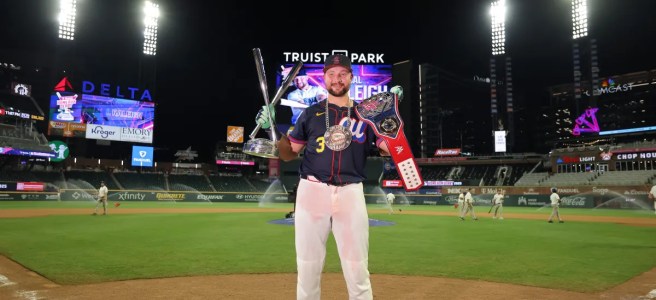
As far as all-star exhibitions in professional sports go, the Home Run Derby is the gold standard.
Eight of the best sluggers in the major leagues facing off with serious hardware and bragging rights at stake. Booming homers littering the outfields of a new ballpark each summer. Nonstop excitement and power for three hours — what could be a better advertisement for the sport of baseball?
I make the Home Run Derby appointment viewing each July, prioritizing it in front of regular season games that count in the standings and the All Star Game. I watched my first Home Run Derby back in 2009 with my cousin Tim Xavier on a family vacation to San Diego, and I still recall him telling me I could be one of the kids in the outfield snagging deep fly balls (and I remember believing him).
2025 was, by a wide margin, my favorite iteration yet. Mariners catcher Cal “Big Dumper” Raleigh came into the eight-player field as the favorite but almost missed advancing past the first round. Raleigh and Brent Rooker of the A’s both hit 17 home runs in the first round and tied in the tiebreaker, distance in feet of the longest home run, but Raleigh’s longest blast exceeded Rooker’s by mere inches. Raleigh only improved in the semifinal and obliterated baseballs in the championship round against Tampa Bay’s Junior Caminero, winning 18-15.
Watching a guy nicknamed “Big Dumper” win the title was a sight to see, but he was no ordinary champion. The first catcher to win the Home Run Derby, Raleigh employed his father as his pitcher and brother as his catcher and showcased his switch-hitting abilities in the first round, smacking moonshots from both sides of the plate. Raleigh staved off elimination with a strong second half in the opening round, then upset top seed Oneil Cruz of the Pirates, who launched the night’s longest home run at 513 feet. While his Monday night performance was special, Raleigh is far from just a Derby darling — he ranks first in the MLB with 38 home runs this season, while ranking third among all position players in wins above replacement (4.8 WAR) and earning the starting catcher nod for the American League in the All Star Game.
While the Home Run Derby doesn’t count and warps the game of baseball to create an entirely different type of competition, the contest matters more than its exhibition label would imply. It’s baseball at its most fun, with each year’s contest emphasizing the sheer athleticism and strength of its contestants and packing intrigue and high stakes into each pitch. The Derby skews toward young, exciting talents and provides a them with a terrific introduction on a national stage. Ken Griffey Jr.’s shots at Camden Yards still reverberate around baseball, and the past exploits of Josh Hamilton and Giancarlo Stanton are some of the most prominent highlights of both sluggers’ careers.
Considering the relatively low stakes of regular season MLB games (there are 162 of them!) compared to other professional sports leagues, the Home Run Derby has carved out a unique role as a compelling midseason exhibition and fully capitalizes on the opportunity. And if competitiveness, a factor that has plagued other leagues’ skills competitions and All Star Games, was ever in question, this year’s tightly-contested bracket definitively dispels that notion (Jazz Chisholm’s brutal three-homer dud excluded).
The Home Run Derby seems to only be getting better and more entertaining with each evolution, while the sport of baseball faces existential crisis after existential crisis. Are there lessons for the MLB to learn from its power-packed showcase that could help elevate the sport as a whole? These are five of the ways that MLB decision-makers could mine the Home Run Derby to develop the future of baseball.
The Spirit of Experimentation
Why this boosted the Home Run Derby: The competition is exponentially better with a time component, and the perpetual tinkering doesn’t detract from the history of the event.
How this could help MLB: The Home Run Derby never seems to be exactly the same, but that dynamic quality has not been to the contest’s detriment. The current format mixes both time (a pre-determined clock to ensure players don’t hit dingers for more than five minutes, roughly) and a fixed pitch number (40 at the beginning). As an exhibition, the HRD has the luxury of testing out new strategies for boosting the entertainment value, and that’s just for a relatively simple contest of hitting the most home runs. The complexity of the sport it is based on gives decision-makers plenty of room for evolution while still keeping baseball’s basics intact, and changes like the pitch clock and ghost runner have helped reduce game durations and emphasized excitement. I’d love to see MLB take an aggressive and long term approach to modernizing baseball to keep growth on an upward trajectory. Not every regular season game has to be its own home run derby — though games at the Rockies’ Coors Field often end up that way — but baseball can make major strides by taking big swings with its rules.
Neutral Site Ballparks for Playoff Games
Why this boosted the Home Run Derby: Atlanta and Truist Park shined as the hosts of the Home Run Derby, both due to Atlanta’s important place in baseball history and the unique ballpark dimensions and features.
How this could help MLB: Every American pro sport with a best-of-seven playoff format splits games between the series’ contestants, but MLB should at least consider having playoff series at a predetermined location. The All Star Game and Home Run Derby take place in a new city each year, which helps celebrate the host and emphasizes what makes its ballpark unique. The Home Run Derby at Truist Park challenged hitters in different ways than the conditions at Coors Field in Denver, another recent host, and older ballparks like Fenway Park with the Green Monster or Wrigley Field with the ivy-covered outfield have even greater variance. The differences between ballparks in their dimensions and conditions makes baseball unique among pro sports, and applying this approach from All Star Week to the playoffs would offer a couple benefits. First, the move would make financial sense, since tickets and preparations for the playoffs would be in motion well in advance instead of the makeshift operations of having high-profile games in different cities over the course of a week. Ballparks would also offer similar capacities, so playoff games will be packed to the brim and bring in comparable revenue even without the boost of a home crowd. Multiple cities could be in the rotation (like Miami, Los Angeles, Phoenix and New Orleans for the NFL’s Super Bowl), allowing the league to highlight the history and significance of different baseball meccas and make playoff series feel more like destination sporting events. The pandemic-era playoffs in 2020 at the Rangers’ Globe Life Field provide precedent for neutral site playoff series. MLB could roll out having a round or two at neutral sites first, but the overall objective of turning playoff series into more of a celebration of the sport, like the All Star festivities, is the ultimate goal.
Giving Stars a Platform
Why this boosted the Home Run Derby: The competition gave each contestant time in the spotlight and illustrated what made each contestant an elite player — even without major league-level pitching involved.
How this could help MLB: Showmanship and spectacle is a strong suit of the Home Run Derby and is a surefire way to get younger fans and more casual audiences invested in the sport. Obviously, baseball teams employ more than just a single superstar slugger, but marketing the sport’s big names should expand beyond teasers during ESPN ad breaks. I’d love to see a Netflix or Apple TV documentary following some of the sport’s biggest names. While reaching the success of previous docuseries like Drive to Survive for Formula One or Quarterback for the NFL is a lofty goal, engaging with new forms of storytelling can help streamline the overwhelming size of the 162-game regular season schedule into more digestible narratives and establish more household names in the sport. The need for better marketing of elite players has been a longtime criticism of MLB’s media approach, but a series into the sport could attract new audiences and build on the momentum of the Home Run Derby.
Using Stats to Explain the ‘Why’
Why this boosted the Home Run Derby: Every statistic enhanced viewers’ appreciation for and understanding of the home runs, from providing the distance used in tiebreakers and bonuses to illustrating why mechanics and launch angle enabled sluggers to go long.
How this could help MLB: Baseball is a numbers game, and the Moneyball era has served to infuse even more statistics and perspectives into the nation’s pastime. The Home Run Derby did an excellent job of incorporating statistics into its Statcast broadcast on ESPN2, providing viewers with relevant information that quantified the power on display and increased the entertainment value. What is the balance between including advanced statistics and overwhelming audiences? In my opinion, the perfect balance is when the utilization of statistics enhances the viewing experience and “wow” moments, and that’s the sweet spot that the Home Run Derby struck last night. Obviously, ESPN also stuck in gambling odds that did the exact opposite, but most of the statistics were in service of explaining why certain hitters were on a roll and comparing their massive feats to blasts of the past. Baseball broadcasts during the regular season have just as many statistics at their disposal, and taking cues from the Home Run Derby’s execution would help casual and diehard fans gain a better understanding of the sport.
Intensifying High-Leverage Moments
Why this boosted the Home Run Derby: The Home Run Derby had four or five transcendent and memorable moments that the contest’s format took to the next level.
How this could help MLB: The Home Run Derby’s rules all but ensured down-to-the-wire battles between contestants that elevated the drama: having four of the eight contestants advance to the next round instead of lopsided predetermined matchups, taking away the clock and pitch maximum for the bonus round so that each contestant could theoretically hit 10 dingers in a row and advance to the next round and incentivizing moonshots by offering bonus opportunities for socking pitches beyond certain distances. Those rule changes paved the way for the razor-thin margins of the battle for fourth place in the opening round, Caminero’s blitz through the second round, the Raleigh-Cruz face-off for a trip to the finals and the suspense of Caminero’s late surge. Some of baseball’s recent innovations have followed a similar strategy, such as adding the ghost runner in extra innings to expedite longer games and open up scoring opportunities, and I’d love to see more innovations targeting high-pressure moments that determine games. Without the high-octane, social media-ready action of sports like football, basketball and hockey, baseball is best when games come down to high-leverage situations that require athleticism, strategy and clutch performance, and developing rule changes to make these more frequent and more strategic would be a worthwhile point of emphasis with potential for long-term positive impact.
 Riker's Block