Nestled between the intensity of the NHL and NBA playoffs and the optimism of the opening stretch of Major League Baseball, the NFL Draft somehow holds its own every year — despite having no games, scoreboard or on-the-field action. On my morning and afternoon commutes, debate over which offensive skill position player the Broncos should draft at 20 gets as much airtime on the local radio station as the Nuggets’ and Avalanche’s first-round playoff matchups combined. And that doesn’t even count the biggest impact the state of Colorado is having on Thursday’s first round — that clear distinction belongs to the Buffaloes’ superstar duo of Travis Hunter and Shedeur Sanders, who very well could land in the top 10 of the draft after must-watch careers in Boulder.
Attribute the rabid interest in the draft to the NFL’s year-round dominance, but the draft deserves some credit as prime springtime entertainment. All 32 NFL fan bases have a reason to tune in and the promise of a brighter future, and the draft is the culmination of months of intrigue, mock drafts and media hype. Still, certain factors turn an entertaining event into a must-watch drama. These are the nine parts of the draft that bolster the evening’s entertainment value and fun factor.
Bold trades — So far, the first round order is untouched, with all 32 teams selecting in their designated slots. Let’s hope that changes. Whether it’s a quarterback-needy team making a move for its passer of the future, a general manager who is enamored with a prospect who would be an excellent fit or a front office that fears a rival will move into position to take its guy, trades add another dimension of calculated risk-taking and creativity beyond the standard select-a-player routine. Did the team that moved up give up too much capital in return? Did they take the right guy to make the trade worth it? Trades can vary in their parameters, motivations and long-term significance, but the shake-up always makes the draft better and more unpredictable. Plus, there’s the couple minutes after breaking news of a trade in which viewers guess why a team moved up, as well as the evaluation immediately following the pick’s announcement. Prime example: Falcons move up 21 spots for Julio Jones, 2011 Draft.
Quarterback selections in the first round — No position defines the success of a draft class nearly as much as the quarterback position. Quarterbacks can change the trajectory of a franchise, either elevating the team to playoff contention or setting them back a couple years with a wasted draft pick. Just look at the 2017 NFL Draft, which sent Mitch Trubisky to Chicago (a pick that did not pan out), Deshaun Watson to Houston (a pick that turned haywire with controversy) and Patrick Mahomes to Kansas City (a pick that turned into three Super Bowl trophies). Quarterback drama stirs interest and sparks optimism unlike any other position, and the picks are closely scrutinized, from the moments they are made until the selections are up for Hall of Fame consideration. Cam Ward and Shedeur Sanders are likely Day 1 picks in 2025, but a trio of lesser-known names, Jalen Milroe, Jaxson Dart and Tyler Shough, could spice up the back half of the first round. Prime example: six teams spend first-round picks on quarterbacks in the 2024 Draft.
Drama in the green room and draft-day tumbles — The NFL invites top prospects to attend the draft each year, but there are no guarantees that invitations correlate with positive draft outcomes. When a prospect (usually a quarterback) sees teams that showed interest in him choose another player instead, the near-misses can turn into a draft-day slide. On the positive side, the player may end up with a better team — Aaron Rodgers fell from being the top pick in the draft to a role backing up Brett Favre on the Packers for a couple years. But the tumble will also cost the player plenty of money when it comes to negotiating his rookie deal, and the embarrassment for invited prospects typically plays out with cameras in their face and camera shots of them all night long as their worst expectations come true. Why does this make the draft better and more interesting? I’ll start off by saying that each of these draft picks ultimately will get picked by an NFL team and earn millions of dollars on their rookie contracts, so I don’t grieve their misfortunate to an overwhelming degree. The slides also offset the nonstop joy of prospects finally making it to the league, a staple of the draft, with the drama and emotion of unmet expectations and the burning competitive fires stoked by any perceived slights. Sanders could be a potential draft-day slider due to the lack of strong fits at the top of the draft, though a Will Levis-like fall to the second day of draft festivities would be a shock. Prime example: Aaron Rodgers, 2005 Draft.
Polarizing prospects — Most players entering the NFL establish themselves in their first seasons and then become household names, but a select few make it to the league with an abundance of notoriety and fanfare to their name already. That popularity can also emphasize the gap between differing opinions of the player and make them difficult to project to the NFL level. Florida legend Tim Tebow is an excellent example of a historically successful college player who did not fit the quarterback prototype but still made it to the first round as a selection of the Denver Broncos. Lamar Jackson also came into the league with a Heisman Trophy to his name but made waves with his insistence on playing quarterback and not wide receiver — a decision that has paid off with two MVP awards so far. A player being polarizing is not necessarily indicative of their worthiness as a high first-rounder or of their ultimate career outcome and can be a better indicator of the evaluator or opinion-holder. Beyond providing drama, these players make the draft feel more interactive and worthy of investment for viewers. As with the previous factor, Sanders is the best example of this phenomenon from this year’s class due to his upbringing as Deion Sanders’ son and skillset as a passer. Prime example: Johnny Manziel, 2013 Draft.
Players on the edge of the first round — Hearing your name selected in the NFL Draft is quite an honor, especially in the opening rounds. But the draft slot matters, and one of the most pronounced differences from one draft slot to the next is the gap between the 32nd and 33rd pick, which constitutes the jump from the last pick in the first round to the first pick in the second round. Aside from the obvious difference of having to wait an additional day to hear names called, second-round picks also have more limited earning potential and are less of an investment for teams, meaning they may have a shorter leash and fewer immediate opportunities. That makes the last couple picks of the first round have significant stakes, even if the top players have long since been off the board. Speaking on the 32nd pick specifically, teams have found tremendous value at the slot and sometimes move into the end of the first round to grab their guy before the end of the night. That’s exactly what happened with the Baltimore Ravens in the 2018 draft, when the Ravens traded for the 32nd overall pick after already drafting tight end Hayden Hurst with their own first-rounder. Baltimore opted to select the future of their franchise in Louisville quarterback Lamar Jackson and has made the rest of the league look silly since. Linebacker Manti Te’o endured the opposite result, tumbling out of the teens and 20s and lasting all the way through the end of the first round without hearing his name called. Prime example: Lamar Jackson, 2018 Draft.
Draft day declarations — Some NFL prospects are overwhelmed with gratitude upon getting a phone call from an NFL team and immediately cede the credit to their families and coaches. Others do not. Former UCLA quarterback Josh Rosen was a top-10 selection by the Arizona Cardinals but is better known for his draft-day quote than his actual NFL career: “There were nine mistakes ahead of me. I will make sure over the next decade or so that they will know they made a mistake.” Rosen won three of his 16 NFL starts, threw 12 touchdowns to his 21 interceptions and was traded away from Arizona a single year after his draft selection, so Rosen’s declaration itself seems more like that evening’s mistake. Rosen would have been remembered much more fondly if he had let his play do the talking, but you can’t fault Rosen’s confidence or the intrigue it added in the ensuing years. One of the quarterbacks selected after Rosen was much more gracious and focused on the grind ahead, and that quarterback has now won a couple of MVPs with the Ravens and looks much closer to his draft-day goal of bringing a Super Bowl to Baltimore. Prime example: Josh Rosen, 2018 Draft.
Super Bowl contenders getting steals — The NFL Draft is designed to help catch the teams with the worst records up with the rest of the pack and bases its first round order on the reverse order of the final standings and results of the previous season. That design makes it all the more agonizing when the league’s reigning dynasties wait patiently at their late slots and then pounce on a promising prospect most analysts expected to go earlier in the draft. Every time the Kansas City Chiefs are on the draft board, terror replaces apathy for fans outside of Kansas City. How can the Chiefs possibly get better? Who will be able to stop Patrick Mahomes if he gets another star talent at his disposal? That sums up the Chiefs’ 2024 first-round pick, Texas speedster Xavier Worthy. Kansas City took Worthy at 28 overall, then utilized him masterfully in the playoffs (19 receptions for 287 yards and three touchdowns in three playoff games). Ironically, the teams at the bottom of the draft boards have performed as well as any other teams in finding great contributors across the seven rounds, and each of their picks has the potential to become a name to know before the next Super Bowl rolls around. Prime example: Xavier Worthy, 2024 Draft.
Absolute head scratchers. One of my favorite phenomena of NFL Draft season is teams’ use of “smoke screens” to distract rivals from their true intentions. The subterfuge can include appearing disinterested in a player the team wishes to target (the Broncos put great effort into hiding their admiration for eventual pick Bo Nix in 2024) or their draft-day strategy. But sometimes, teams seem to juke common sense itself out. The Falcons devoted $100 million in guarantees to land quarterback Kirk Cousins in free agency last year, seemingly designating him as their QB1 for the next three seasons. Just over a month later, they spent even more of their resources on the quarterback position by selecting Washington’s Michael Penix Jr. with the eighth overall pick instead of bolstering the roster around Cousins. Both Cousins and Penix were recovering from injuries, and the 2024 season went about as smoothly as the post-draft press conference went: Cousins struggled post-injury and was benched with the NFC South title still up for grabs, sending Penix into do-or-die games in his first NFL action. The Falcons’ thought process, both immediately and a year later, was bewildering to fans, but the absolute curveball gave the draft a breaking news headline and plot twist for the ages. Prime example: Michael Penix Jr., 2024 Draft.
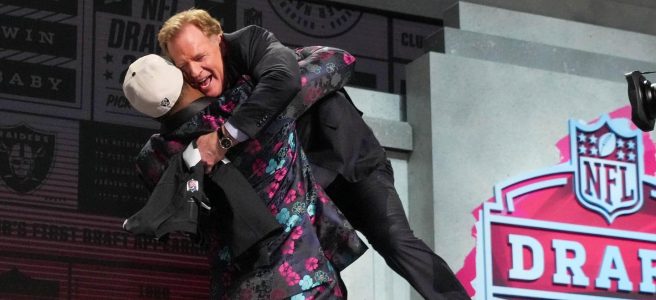
Roger Goodell bear hugs and memorable draft celebrations — The joy of NFL draft day is an essential aspect of the event and never gets old, whether prospects stand up in the green room to embrace their families or take a phone call from their couch at home. But the hugs can reach another level, too. Watching a newly-minted NFL offensive lineman bear hug league commissioner Roger Goodell is excellent television and adds humor to the draft to complement the drama. The Raiders’ Tyree Wilson has the best hug to date (and likely scariest for Goodell), lifting the league commissioner up and off the ground in a pure display of excitement and euphoria. Other entertaining aspects of prospects “getting the call” include the eternal battle between family members and girlfriends to hug the player, prospects playing NFL-caliber defense to protect their cell phone and draft selections putting questionable fashion choices under the spotlight. Prime example: Tyree Wilson, 2022 Draft.
BONUS – 2025 NFL Mock Draft (Top 10)
- Tennessee Titans – Travis Hunter, WR/CB, Colorado – All signs are pointing to a QB at one, but Titans go best player available with the first overall pick.
- Cleveland Browns – Cam Ward, QB, Miami – Cleveland opts to reset at the quarterback position with another Heisman Trophy finalist.
- New York Giants – Shedeur Sanders, QB, Colorado – Quarterbacks Russell Wilson and Jameis Winston provided short-term options for New York in free agency, but Sanders presents tantalizing long-term upside.
- New England Patriots – Abdul Carter, EDGE, Penn State – Carter slides out of the top three due to injury concerns, but the Patriots are happy to pounce as they shape head coach Mike Vrabel’s defense.
- Jacksonville Jaguars – Tyler Warren, TE, Penn State – Jacksonville’s decision to go for the offensive skill positions paid off last year, and they go pass-catcher again by taking the draft’s top tight end.
- Las Vegas Raiders – Mason Graham, DL, Michigan – Las Vegas addressed its offense by trading for Geno Smith, but the Raiders fortify the trenches on defense with their top draft pick.
- New York Jets – Armand Membou, T, Missouri – Membou is a surprise as the first offensive lineman off the board and will help lead the Jets into a new era with head coach Aaron Glenn and quarterback Justin Fields.
- Carolina Panthers – Will Johnson, CB, Michigan – Carolina adds Johnson to pair with star corner Jaycee Horn and to help shore up the NFL’s last-ranked defense in 2024.
- New Orleans Saints – Tetairoa McMillan, WR, Arizona – New Orleans is iffy at quarterback, but the addition of McMillan as the WR1 of the draft will be a major boost for new head coach Kellen Moore’s offense.
- Chicago Bears – Ashton Jeanty, RB, Boise State – Jeanty, the Heisman runner-up, joins one of the youngest and most exciting offenses in the NFL (on paper) as Chicago attempts to climb back into NFC North contention.
 Riker's Block