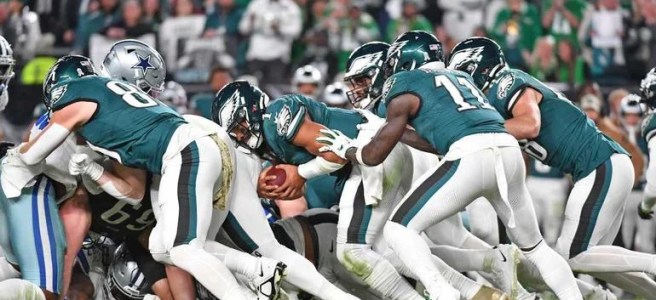
NFL teams failed to stop the 2024 Philadelphia Eagles on the football field. So now, they appear to be playing defense in another way — an attempt to legislate the Eagles’ trademark play, the tush push, out of the rulebook ahead of the upcoming season.
The Green Bay Packers proposed a rule change that would ban the play, in which offensive players line up behind the quarterback and push him through the offensive line and across the first-down or goal-line marker. While other teams have attempted to emulate the Eagles’ success, Philadelphia has made the play almost unstoppable. Quarterback Jalen Hurts has rushed for at least 10 touchdowns in each of the past four seasons, along with 10 postseason rushing touchdowns across the Eagles’ Super Bowl runs in 2022 and 2024. Hurts and the Eagles’ offensive line have turned short-yardage situations into almost automatic conversions for the Eagles’ offense thanks to the play, which rose to prominence in 2022.
The Packers’ proposal did not get a definitive answer at this week’s owner’s meetings. Teams opposing the play cite increased injury risk and lagging pace of play, while its proponents claim that it is unfair to outlaw a permissible football play just because the Eagles are so dominant at it. According to Jonathan Jones of CBS Sports, 16 teams are against the rule change, with further discussion to come over the next few months. For the rule to pass, 24 out of the 32 teams are required to vote in favor of the change.
The longer the drama and debate goes on, the more entertaining this situation gets. As if having the nicknames “Tush push” and “Brotherly Shove” and a league-wide conflict over butt-pushing isn’t hilarious enough, the play has had memorable moments on and off the field, from the Eagles’ repeated attempts during the NFC Championship Game that almost led the game’s referees to award Philadelphia a touchdown for repeated Commanders penalties to reigning Offensive Player of the Year Saquon Barkley’s late-night television comment that his role is to be the one to push the tush. The variance in opinions across the league and divide right down the middle make this phenomenon a polarizing and fascinating topic, one in which each side posits its solution as common sense.
The most buttoned-up, serious reason behind the anti-push proposal is the injury potential with the play. Reducing injury risk has been a key motivation behind the NFL’s revamped kickoff rules, so the motivation of making football safer has proven to resonate with the league and its owners in recent years. But unlike the high-impact collisions that led to the extinction of the old kickoff style, the tush push is at the opposite end of the spectrum. The play requires quick instincts, from the snap and push on the offense’s side to the defensive line’s reaction, but the players are lined up in close proximity and don’t have a running start — making this a play more dangerous for its strength than its speed. Though the sample size of tush pushes is relatively small, teams opposing the play cite potential for neck injuries and dangerous postures in the pile-ups, and much of the discussion regarding the legislation is determining the validity of these claims.
Is the tush push, a slower and shorter play, much more dangerous than a typical, high-flying football play? Will eliminating the ability of a player to push his teammate forward have more than a marginal effect on injury risk relative to a standard quarterback sneak, which includes many of the same risk factors? That’s for the rules committee to decide and is the closest aspect the anti-push movement has to a serious, nonpartisan angle.
Thankfully, the debate has deliciously tense and polarizing angles to it as well. One is the ugliness of the play. The Eagles had plenty of flashy touchdowns, from Barkley’s 60-yard rushing touchdown to put Philly on the board in the NFC Championship Game to Hurts’ brilliant 46-yard touchdown strike to DeVonta Smith in the Eagles’ Super Bowl LIX victory. The tush push is obviously the opposite, two teams pitted against each over to battle and grind over a yard or two. The tush push is not an aesthetically-pleasing play outside of true offensive line enthusiasts, but for the Eagles and a couple other adopters like the Buffalo Bills, the play has become an effective option that has rewarded innovation.
The feistiest point of contention is over the Packers’ perceived intentions of outlawing the play to slow the Eagles’ dominance — specifically, that the Eagles are too good at performing the play and have turned it into an automatic conversion. Teams looking to vote against the tush push would never admit to that objective, because changing a legal rule available to all teams to stop one team is laughable and not nearly as convincing as injury risk or pace-of-play angles. The Eagles are terrific at the tush push because of their fantastic offensive line, massive quarterback and flawless execution, and nothing is stopping other NFL teams from improving at any of the three. Philadelphia is simply the only team that has made the play automatic, and its success in short-yardage situations helped propel the Eagles to a Super Bowl title.
The NFL has been no stranger to rule changes, overhauling the kickoff procedures in this past year and experimenting with both successful changes (extra points are more fun to watch after increasing the distance) and unsuccessful ones (challenging pass interference penalties only lasted a year). This rule change, though, has turned into quite the saga. Is the aim of the tush push ban to bring the NFL forward, or push the Eagles backward? The structure of the play itself provides an apt visual: two sides clashing against each other, fighting it out over one yard of very impactful green grass. Short of the billionaire owners actually lining up in formation and trying it themselves to decide, this hilarious debate may be the next best, most entertaining thing.
 Riker's Block