The games bookending the Ravens’ 2024 season finished in eerily similar fashion: road contests against playoff-tested AFC contenders that saw Baltimore’s late rallies falter with failed attempts to knot up the score.
In Week 1 — the first game of the entire NFL season — the Ravens looked out of sorts against the Kansas City Chiefs but nearly came back from a 10-point, fourth-quarter deficit. On third-and-goal from the Chiefs’ 10-yard-line with five seconds left, quarterback Lamar Jackson appeared to connect with tight end Isaiah Likely for a play that was initially ruled a touchdown… until Likely’s foot was confirmed to be touching the back boundary of the end zone by a matter of inches.
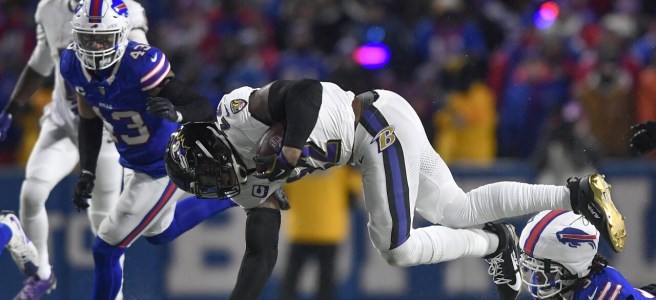
In yesterday’s divisional round bout against the Bills in snowy Buffalo, Baltimore struggled with turnover issues and didn’t look the part of a divisional champion. Still, the Ravens rallied to turn a 21-10 halftime score into a slim 27-25 deficit, with Likely’s 24-yard touchdown snag drawing the Ravens within a two-point conversion. The Ravens never completed that rally, though, as Pro Bowl tight end Mark Andrews couldn’t corral a picture-perfect pass from Jackson in the flat to tie the score, despite no defenders in the area.
In both instances, the game effectively ended on a tantalizing, unrealized ‘what if.’ If the officials’ original call stands in the season opener, the Chiefs-Ravens head to overtime, or the Ravens attempt a two-point try for the lead and win. If Andrews secures Jackson’s on-the-money throw, the Ravens stay alive and even up the score.
Both hypotheticals would have boosted the Ravens’ hopes and sidestepped the eventual agony of the real-life results. But those two plays don’t explain why Baltimore did not live up to its potential in another supposed boom-or-bust year.
The 2024 Baltimore Ravens had everything necessary to win the Super Bowl: an experienced head coach and front office, an unstoppable, MVP-level quarterback, an array of playmakers on both sides of the ball and above-average injury luck. Inconsistency, whether game-to-game or from the regular season to the playoffs, sealed their fate.
Let’s start with the regular season.
Lamar Jackson, already a two-time MVP, somehow improved his game even further. Jackson earned first-team All-Pro honors and threw for more than 4,000 yards and 40 touchdowns in the regular season, against just four interceptions. He also had help on offense, in the form of the best season any offensive teammate of Jackson’s has had to date — offseason acquisition Derrick Henry’s age-defying, season-long romp. Henry rushed for 1,921 yards and 16 touchdowns on a career-best 5.9 yards per carry, despite already turning 30 and adjusting to a new offense. Zay Flowers became the first Ravens receiver to make the Pro Bowl, and the defense emerged as one of the league’s stoutest at stopping the run. The Ravens swept Cincinnati to help knock the Bengals out of the playoff picture and zoomed by Pittsburgh in the final stretch of the regular season to defend the AFC North crown.
12-5 is not a terrible regular season record, and, crucially, not one that disqualifies Super Bowl contention. Last time, the Ravens won a Super Bowl, they only tallied 10 regular-season wins, fired their offensive coordinator midseason and had to travel to chilly Colorado and Massachusetts to punch a Super Bowl ticket. But it’s impossible to ignore the impact of shocking losses to the 4-13 Las Vegas Raiders and 3-14 Cleveland Browns on the Ravens’ playoff seeding. Win either or both of those, and the Ravens would not have been relegated to the third seed or have needed to visit Buffalo or Kansas City to reach the Super Bowl.
Assessing a team’s failure to advance is not about singling out the final nail in the coffin, but deducing the reason the coffin was even there in the first place. The Ravens’ up-and-down play didn’t eliminate them but significantly damaged their hopes, narrowing their margin for error. Their second playoff game became a microcosm of that exact trend.
Similar to the Ravens’ inability to parlay a competitive effort against the Chiefs into a convincing win over the lowly Raiders or extend a five-game win streak to six against Cleveland, Baltimore did not establish the same identity that made them a contender in the regular season against the Bills.
This is not a new issue for the Ravens. Since Lamar Jackson arrived in Baltimore as the 32nd overall pick in 2017, the Ravens have underperformed in the postseason, whether faltering as the top seed in the AFC in Jackson’s two MVP seasons or getting knocked out on the road by Cincinnati and Buffalo. From turnovers to pass-happy play calling to near-misses in the clutch, the Ravens simply struggle to assert the identity that makes them so dangerous in the regular season again in the playoffs.
Against the Bills on Sunday, the Ravens’ coaches did their part, evidenced by a 416-273 advantage in total yardage and a strong start out of the gates. Holding MVP candidate Josh Allen to 127 yards and no passing touchdowns is a near-best-case scenario for first-year defensive coordinator Zach Orr, too. Unlike past playoff outings in which the Ravens strayed from their dominant run game because of the bright playoff lights, Baltimore had a definitive edge in that category, as well.
The reason the Ravens found themselves in the coffin by the fourth quarter was their turnovers. The NFL’s best team in avoiding takeaways in the regular season committed three against the Bills, and those three plays proved to be especially damaging. Jackson’s interception on a deep pass for Rashod Bateman spoiled a chance for the Ravens to take back their early lead, but his inexcusable fumble on the Ravens’ next drive, which Von Miller returned for 39 yards to the welcome mat of the red zone, directly led to Buffalo’s go-ahead touchdown. Buffalo never trailed again and put Baltimore in a 21-10 hole by halftime.
The Ravens’ third and final turnover, Mark Andrews’ fumble with just under nine minutes remaining, set Baltimore’s comeback bid further and positioned the Bills to turn a five-point advantage into an eight-point lead. Meaning, even a successful Ravens touchdown and two-point conversion would give Buffalo a chance to answer, rather than giving Baltimore its first lead since the first quarter. That difference proved crucial when Jackson directed the Ravens on an inspired final drive, only to need that two-point conversion to tie and come up short.
With such a definitive yardage advantage and strong performances from their best players, the Ravens should never have faced a double-digit deficit or found themselves in a fourth-quarter scenario in which they could only tie and hope to stop Buffalo quarterback Josh Allen with a minute and a half left. And as important as that two-point conversion was in potentially knotting the score, did the Ravens even have the win probability in their favor if Buffalo had the final possession in regulation?
When a team loses the turnover battle by three takeaways, the opposing team simply needs to stay afloat and take the modest wins, rather than the magic and miracles required of the team in the negative. Buffalo’s offense did not set any franchise records, but 27 points and 10 points off turnovers is more than enough to get by when the defense gifts three prime opportunities.
Of the 10 teams eliminated so far in the postseason, the Ravens should feel most bullish about their chances in 2025. Baltimore’s coaching staff and key roster pieces should be back, and the offseason will provide opportunities to shore up weaknesses on the offensive line and defense. The Ravens are also coming off a 12-win season with an MVP-caliber quarterback — something no other playoff loser can claim (Jared Goff is not an MVP-caliber quarterback, in my book). Barring an injury-plagued 2025, the Ravens have what it takes to be a Super Bowl champion.
But are the Ravens any closer to winning a Super Bowl than they were this time a year ago? Baltimore won fewer regular season games, lost a round earlier in the playoffs, regressed defensively and allowed Buffalo to outclass them on a playoff stage, after beating the Bills 35-10 on Sunday Night Football in September. The answer, as reflected by those results, is no.
The Ravens will need to establish their identity and do what makes them great — and eliminate the errors that reflect the opposite — in the playoffs to make it to and win the Super Bowl. Head coach John Harbaugh’s early Ravens teams did exactly that in his first four years, and it’s a formula that has birthed dynasties in New England and Kansas City.
Unfortunately for Baltimore, the NFL season is unforgiving and playoff opportunities are precious. This isn’t the Madden NFL video game. If the Ravens truly do become a better team and worthy of a Super Bowl spot, they’ll have to wait a full year to prove it.
 Riker's Block