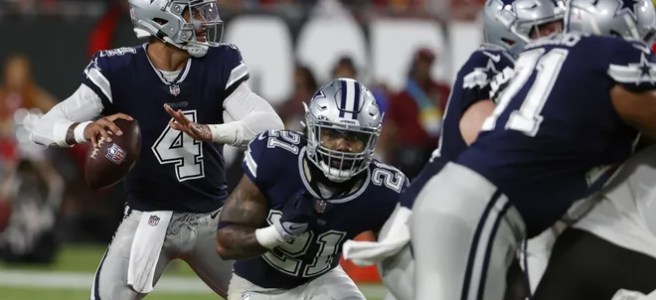
The 2023 Dallas Cowboys probably hit their peak on Dec. 10, 2023 with a commanding 33-13 rout of the archrival Eagles at AT&T Stadium.
Propelled by an efficient showing from quarterback Dak Prescott and a defensive effort that included three recovered fumbles and only six points surrendered to the potent Philly offense, the Cowboys took control of the NFC East and improved to 10-3 (and 7-0 at home) with the win. The divisional victory boosted Dallas’ hopes of the number one overall seed — and home-field advantage through the NFC side of the playoffs — and Prescott’s credentials as the MVP (he eventually finished second in the award’s voting to Baltimore’s Lamar Jackson).
The game represented exactly why the Cowboys had reason to believe that the 2023 season could have a different outcome than the seasons of the past decades and lended legitimacy to a schedule that had been light on wins against quality teams.
Dallas failed to convert that 10-3 start into a single playoff win. The Cowboys lost their next two games to the Bills and Dolphins, dooming their chances for the NFC’s top seed, and, in arguably the most shocking result of the playoffs, gave up 48 points to the seventh-seeded Packers at home in a Wild Card matchup Dallas was favored to win by more than a touchdown.
Worse, the Cowboys’ Week 10 high point could be out of the grasp of the 2024 squad. As bad as the playoff loss to the Packers felt for the Dallas franchise and fanbase, the offseason has felt even more sluggish and sour. Consider the major developments in Big D since that playoff loss, in chronological order:
— Head coach Mike McCarthy keeps his job after another poorly-coached playoff defeat.
— Defensive coordinator Dan Quinn is hired by a division rival, Washington, as its head coach.
— The Cowboys remain virtually silent during free agency, while the rest of the NFC contenders improve.
— Dallas and Prescott move closer to a contract stalemate after his near-MVP season.
— The Cowboys make one of the strangest offseason moves by bringing back Ezekiel Elliott to replace Tony Pollard.
— Dallas veers from its “win now” mandate during the NFL Draft by opting for developmental tackle Tyler Guyton.
Individually, these moves aren’t entirely abysmal. McCarthy has been one of the league’s winningest coaches since arriving in Dallas and is coming off an NFC East crown, while waiting on Prescott’s contract might have prevented a reactionary overpay. The Guyton pick could pay off in the long run, even if the immediate returns aren’t in line with some of the Cowboys’ recent first-round picks. Dallas did not hinder its long-term outlook with terrible contracts in free agency.
But it’s impossible to argue that the Cowboys got better this offseason, because it sure appears that they did not try to improve.
The attrition of the roster and coaching staff is a definite takeaway. The Cowboys’ best coach, Dan Quinn, took the top job in Washington, while the league’s top offense will be without running back Tony Pollard (Tennessee), receiver Michael Gallup (Las Vegas), center Tyler Biadasz (Washington) and tackle Tyron Smith (New York Jets).
Of those losses, Pollard’s departure preceded the Cowboys’ most curious move, the signing of the 28-year-old Elliott. In 2023 with the New England Patriots, Elliott recorded the worst season of his career, with clear career-low marks in yards per carry (3.5), rushing touchdowns (3) and rushing yardage (642). He also finished the season without a 20-yard carry in 184 rushing attempts and rushed more than 10 times just twice across the Patriots’ final nine games. Elliott brings familiarity and versatility in his Dallas return, but the explosiveness that made him the Cowboys’ fourth overall pick in 2016 has been gone for years. Elliott’s presence as the top option in Dallas doesn’t bode well for the Cowboys’ rushing attack or Prescott’s ability to pick apart opposing defenses through the air.
On its own, the addition of Elliott as the Cowboys’ top running back seems more safe than inspired. The move became more puzzling given current Ravens running back Derrick Henry’s admission that the Cowboys didn’t contact him as a potential addition to their backfield.
For a team that looked to make offseason moves to “win now,” according to owner Jerry Jones, the Cowboys’ lackadaisical offseason approach is in stark contrast to their lofty goals. Combine coaching downgrades, veteran departures, long-term drafting strategy and, of course, an extremely conservative free-agency approach and it’s hard to identify any progress Dallas made since bowing out of the playoffs.
The Cowboys should challenge for the NFC East title and a playoff spot, in large part due to their track record of regular season dominance (Dallas ranked first in points per game scored and fifth in points per game allowed) and the return of an MVP candidate in his prime at quarterback in Prescott. Contention for a Super Bowl appearance is another story.
At the top of the conference, the contestants from last year’s NFC Championship, the 49ers and Lions, have superior rosters and coaching staffs to Dallas while returning more of their key contributors. Philadelphia responded to its bitter end to 2023 aggressively and with the clear intent to improve its chances, signing running back Saquon Barkley, defensive end Bryce Huff, linebacker Devin White and defensive back C.J. Gardner-Johnson. The talented Falcons improved the quarterback group by signing Minnesota’s Kirk Cousins and drafting Michael Penix, Jr., while the Cowboys’ playoff nemesis, the Packers, picked up one of the best running backs on the market in former Raider Josh Jacobs.
Take a look at the Falcons for an example of a team matching its offseason approach to its championship window and stage of roster construction. Atlanta came into the offseason with a clear goal of overhauling its quarterback duo of Taylor Heinicke and Desmond Ridder and addressed both its present and future by signing the top free agent on the market in Cousins and drafting Penix in the top ten of the draft. The sequence of quarterback acquisitions raised plenty of controversy, but between the improvements at quarterback and new voices at quarterback, the Falcons should enter 2024 as favorites and made moves that should help them end up in a better place than their disappointing 2023. The Steelers’ quarterback refresh, the Chargers’ hiring of head coach Jim Harbaugh and the Texans’ flurry of activity across the roster are just several of the other examples across the league.
Regardless of if the Falcons’ maneuvers work out, Atlanta made moves with considerable upside. The Cowboys just sat the offseason out. For most of free agency, Dallas sat dead-last in free agent signings, while having arguably the most pressure of any team in the league to perform well in 2024.
If 2024 turns out to be the Cowboys’ year, they will have accomplished what has eluded them most in recent seasons — translating their regular-season success to the playoffs in January. That will require Dallas to avoid coaching errors in the playoffs (which has not happened in losses to San Francisco and Green Bay over the past three postseasons). Similarly, the Dallas offense will need to show up ready to play, after posting just seven first-half points in the 2023 finale, six in the 2022 finale and seven in the 2021 finale.
Very little about the Cowboys’ offseason inspires confidence in their ability to correct those shortcomings this time around, but America’s Team has the experience and talent to make those strides and quiet Stephen A. Smith. If they can’t, the Cowboys’ 2025 offseason might very well be characterized by sweeping changes and desperate moves, rather than inactivity, next winter.
 Riker's Block
One thought on “Opinion: All the Cowboys needed to do this offseason was attempt to improve. Now, Super Bowl contention might be out of reach.”